Showing posts with label upstartHRBen. Show all posts

Tuesday, 16 October 2018

Guest Article: Announcement: New HR Certification Materials are Live! by Ben

I had a powerful moment last week. I went back and checked some of the statistics on the website for how people find the blog, and there have been tens of thousands of HR pros that found upstartHR via Google because they were looking for help with HR certification content. That truly blew me away!

It’s that kind of support that has encouraged me to work on developing critical study materials that fill the gaps in the HR certification industry. I made a quiet announcement last week to all of our customers so far this year, but today I’m announcing publicly that our new revised courses for PHR and SPHR certification prep are both available.

(read on for how to get a limited time 20% discount on the course you need!)

hr certification courses

Why a new course? What was wrong with the old one?

The changes in this year’s HRCI body of knowledge prompted me and the team to make changes to the content, and I’d already been thinking for some time that I wanted to move away from the old format to a more comprehensive study platform. I have partnered with Thinkific, an online learning system, to transition the PHR and SPHR courses to a new format that helps learners wherever they may be.

Additionally, during the transition I not only was able to weave in some additional content from video, audio, and external sources, but I was also able to pull together hundreds of practice questions to assist with study preparation. Now students that use the course are not only getting the industry’s only study materials that offer a practical perspective—they also get a wide variety of practice questions to help them test those concepts they’re learning.

Is this the end goal?

Not by a long shot. The course has always been designed to be used alongside another study tool. HRCP has been a great partner in that regard, but I also recommend the Reed books on Amazon for anyone that needs something more budget-friendly (even if it’s for an older version of the test, 99% of the principles are still the same!).

However, those resources are highly academic in their approach, and the number one reason people fail the HR certification exams is because they lack the practical insights around application. In other words: you learn the theories, but you fall down when it comes to talking about how they really work in practice.

The content in the upstartHR course is very practical and written from an “in the trenches” perspective, which means students aren’t just memorizing terms with no idea of how they function in the real world. It’s my plan to continue fleshing out the course until it is able to stand on its own, though this is a long-term plan. Additionally, I will be incorporating new resources, research, and information into the course on an ongoing basis to ensure students are always receiving the latest and greatest information.

What about the SHRM exams?

These tools have been used successfully by dozens of students in the last year. I was hesitant to make this claim without some evidence to back it up, because the course was designed for the HRCI exams. However, there aren’t two wildly different ways to practice HR, there’s one right way. The feedback from SHRM-CP and SHRM-SCP students has been very positive and I’m proud to say that it can help those studying for the SHRM exams with key concepts and practical insights and case studies.

A note about the popular audio course

A final note: the audio course was developed as a tool to help solve a variety of problems (students wanted to listen to materials, study on their commute, etc.), but I’ve heard from some students that the content navigation and user interface is not as easy as they would prefer. I’m working on a solution to this, but, as with the course, it isn’t a quick fix. Some of the audio content is being merged into the PHR and SPHR courses and some will stand alone, but I am working on this to create a better experience for students.

Celebrate with a discount!

Bottom line: this is an exciting time for me and the team. To celebrate, for a limited time I am offering a 20% discount on the new courses if you are preparing for the PHR or SPHR. Use discount code “20launch” at checkout. This code is good until Halloween (October 31st, 2018) so don’t miss your chance! Access to the course does not expire so you can take the exam this winter or any time next year if you’re already thinking about it.

As always, if you have questions feel free to reach out to me in the comments below or via email. It’s an honor to serve the HR community and I look forward to another great year of success with my students!


Article source:Ben - Announcement: New HR Certification Materials are Live!»

Check out more of Ben Uebanks' work at Upstart HR

Friday, 12 October 2018

Guest Article: We’re Only Human 41: HR Leaders, Stop Treating the Symptom by Ben

“HR should see themselves as the sole source of people exertise in any organization… You don’t go to IT to get ideas on how to formulate product. You go to them for [technical] expertise.”

How many times do you solve a problem only to have it come back around again? Are you treating the symptom instead of treating the root issue? In today’s conversation with Cheree Aspelin, Ben asks about how HR leaders can get beyond this common issue.

In Cheree’s words, HR needs to “buck up” and make some tough choices about how to lead the business and the function. It’s an encouraging conversation because Cheree’s passion and excitement about HR as a profession come through in her words, tone, and message.

Connect with Chereee on LinkedIn: https://www.linkedin.com/in/chereeaspelin

If you enjoyed this episode you’ll want to check out “How to be a Chief Troublemaker in HR.”

What about you? Does this resonate? Are you treating the symptoms or the real problem? 


Article source:Ben - We’re Only Human 41: HR Leaders, Stop Treating the Symptom»

Check out more of Ben Uebanks' work at Upstart HR

Saturday, 6 October 2018

Guest Article: Should Employees be Paid for Commuting Time? by Ben

An interesting piece of research on publicly available WiFi access in England led to a question that made me pause. Should employees be paid for commuting time?

As someone that travels a fair bit for work, I know the value of being able to connect and work from any number of strange locations–restaurants, hotel lobbies, airports, etc. But what about the commutes that make up a significant part of the day for so many workers? From the piece:

Interviews with customers revealed why internet access was as important for commuters as business travellers. Many respondents expressed how they consider their commute as time to ‘catch up’ with work, before or after their traditional working day. This transitional time also enabled people to switch roles, for example from being a parent getting the kids ready for school in the morning to a business director during the day.

Until now, there has been little research to evaluate the impact free Wi-Fi provision has had in the UK, despite government encouragement for companies to provide access on transport networks. The researchers looked to Scandinavia to see how commuting time could be measured differently, and found that in Norway some commuters are able to count travel time as part of their working day.

Dr Juliet Jain told the conference: “If travel time were to count as work time, there would be many social and economic impacts, as well as implications for the rail industry. It may ease commuter pressure on peak hours and allow for more comfort and flexibility around working times. However it may also demand more surveillance and accountability for productivity.”

Changing the Script on Work/Life Balance

Twenty years ago commuters riding on trains and other passive modes of transportation (basically anyone that’s not driving, biking, or walking to work) might have been able to work in some capacity, but it was very limited.

Today, with 24/7 access to networks, resources, etc., the conversation has changed. The very technology that has forced us to have very tough conversations about work/life balance could now offer a small way to add more balance to our lives.

We know that more than 90% of workers say they are LEAST PRODUCTIVE IN THE WORKPLACE, which means they need to find other times and places to be productive and meet their work goals. Could this option to get paid for working during commuting hours change that? What’s your take? Is it a good idea?


Article source:Ben - Should Employees be Paid for Commuting Time?»

Check out more of Ben Uebanks' work at Upstart HR

Saturday, 22 September 2018

Guest Article: How AI is Changing HR for the Better by Ben

Last week I was one of several thousand people that attended the 2018 HR Technology Conference and Expo in Las Vegas. I had the opportunity to share about my take on the HR Technology landscape as it pertains to AI and automation technology that is affecting recruiting, talent management, core HR, and more.

In the video below, I answer a few key questions about how AI is driving value for employers that leverage it to solve HR and people-related challenges. This is from my upcoming book (now available for presale!) on Artificial Intelligence for HR. It’s a very practical look at where HR is today and how technology can enable us to FINALLY be strategic in ways we’ve always dreamed of by automating some of the simpler, transactional components and “grunt work” that we all have to do on a daily basis.

Plus, I grew a mini beard for HR Tech this year. Enjoy. :-)

I am planning a special presale bonus for the book. If you want to get in on it just sign up over at http://aihrbook.com and I’ll let you know what you can get for being a presale buyer!


Article source:Ben - How AI is Changing HR for the Better»

Check out more of Ben Uebanks' work at Upstart HR

Tuesday, 11 September 2018

Guest Article: How to Legally Avoid Paying Overtime Wages [Reader Question] by Ben

I’m trying out a new Q&A format for some questions I’ve received in the last few weeks. Let me know what you think in the comments or by emaiing me your own question to ben@upstarthr.com

overtime clockLast week I got a question in the mailbag that was short and to the point.

How can we avoid paying overtime to employees?

My answer was short and sweet:

I’m pretty sure that there is a point to making overtime wages a required thing, and it’s to avoid questions like this. In reality, the way to avoid paying overtime is to work people less than 40 hours a week, manage a balanced staffing plan so that you have enough floaters and part time help to fill the gaps, and closely watch your trends in customer needs and staffing to make sure they match up.

I’d like to take a deep dive into this conversation and offer some specifics, because I think it’s a common question. I’ve heard many times over the years a variation on this: why pay out extra money when you don’t have to? How can you reduce costs and help the company be more profitable? What strategic part can HR play in this discussion?

Some of the key factors in overtime (especially high usage) may not be related to the actual job duties at all. For example, I’ve often found that overtime can be attributed to performance issues on the employee or the manager side of the equation. While that might not always be the case, it does come up more often than I’d care to admit.

Additionally, if OT is an issue, then the company needs to understand what is truly driving the overtime usage. Which people, which tasks/projects, etc. Is it variable or fixed in terms of workload? The answers to those questions will tell you what to do next. Is it a performance issue? A staffing issue? A workload issue? Each piece of that puzzle contributes in some way to overtime problems, and it’s important to dig deep and find out which is actually driving the numbers.

The short answer, though, is that you can’t legally avoid paying overtime. Don’t even try. Some employers get the bright idea to “make” employees exempt/salaried to avoid overtime costs, but that can’t just happen based on a whim. Additionally, it comes with other challenges that employers often don’t want to deal with.


Article source:Ben - How to Legally Avoid Paying Overtime Wages [Reader Question]»

Check out more of Ben Uebanks' work at Upstart HR

Wednesday, 5 September 2018

Guest Article: Your CEO “Steps In” to Help a Troubled Project: Good Practice or Not? by Ben

This year I’ve watched with some interest the saga of Tesla, which is run by Elon Musk. He’s a genius with technology but seemingly less so with human relationships. Musk is known for making bold claims about technology and innovation, but Tesla has faced some struggles to meet production deadlines and more. This is from a few months back but the story and question are still relevant:

You can probably argue over whether it’s a good or a bad sign, but Tesla CEO Elon Musk confirmed on Twitter today a report in The Information that he has taken over direct control of the division that’s producing Tesla’s Model 3 electric sedan after the company failed to meet the delivery goals it set.

Specifically, Tesla had intended to produce 500 Model 3 cars per day, or 2,500 per week, by the end of last month. But according to a company-wide email to employees that was sent today and obtained by Jalopnik, Musk said Tesla has been making closer to 2,000 of the cars per week. (Musk estimated last July that Tesla would be making 20,000 of the cars per month by December.)

In his email — fired off at 3 a.m. PDT — Musk added that if “things go as planned today, we will comfortably exceed that number over a seven day period!”

Musk may have been referring in part to the reorganization. But while The Information reported that Musk had seemingly “pushed aside the company’s senior vice president of engineering, Doug Field, who had been overseeing manufacturing in recent months,” Musk quickly took issue with that characterization of events.

The question I have for you is this: what does it say when the CEO “steps in” to take over in this scenario? Let’s look at the bright side:

  • There’s no way someone can say the CEO isn’t engaged actively in the business and its success.
  • The CEO can calm investor fears and show some initiative at a critical time.

The challenges, though, are pretty obvious:

  • If you’re the employee that was “stepped over,” then you are probably not going to stick around afterward without good reason. You were hired to do a job and you either failed or the CEO made promises too big for you to keep.
  • If you go with the “hire people smarter than you” philosophy, which is a great way to build a strong, high-performing team, then you technically aren’t as good as that person at running the show. Hmmm…

What is your thought? Good plan? Bad? A mix of both? What would you do if your CEO “stepped in” to take over operations or even HR for a period of time during a crisis?


Article source:Ben - Your CEO “Steps In” to Help a Troubled Project: Good Practice or Not?»

Check out more of Ben Uebanks' work at Upstart HR

Friday, 24 August 2018

Guest Article: We’re Only Human 40: How Southwest Airlines Lives and Breathes Corporate Culture by Ben

collette williamsonDoes corporate culture matter? Does it really? In today’s interview, Ben talks with Collette Williamson of Southwest Airlines about the company’s approach to culture, hiring, and training.

It’s quickly apparent that culture is about more than just a fluffy set of core values on the wall at corporate headquarters–it’s about a way of life that makes the company fundamentally different than the competition.

In the interview you’ll hear from Collette how the company takes that 2% of applicants that make it through the hiring process and helps to mold them into the people that serve and love their customers in an almost fanatical way. The stories will make you laugh (and may just make you cry), so we hope you enjoy the show as much as we did recording it.

To learn more feel free to reach out to Collette on LinkedIn or, as you might have guessed, check out the Southwest blog site to learn more about the company.


Article source:Ben - We’re Only Human 40: How Southwest Airlines Lives and Breathes Corporate Culture»

Check out more of Ben Uebanks' work at Upstart HR

Monday, 20 August 2018

Guest Article: #DisruptHR HSV 1.0 is in the books! by Ben

Last week I did something here on the blog that I haven’t done in a LOOONG time. I didn’t post anything. But it wasn’t because I had nothing to say–it’s because I was neck deep in final preparations for DisruptHRHSV, which happened last Thursday night.

This event was a long time coming and we had participants from as far away as Houston and Atlanta come to join us for the event. With about 150 participants, including 14 speakers and a handful of amazing sponsors, there were plenty of balls to juggle leading up to the session!

Bottom line: it was pretty darn amazing. If you were there, I appreciate your support and your participation. If you weren’t, I hope you can join us next time (more to come on this)! We’ll be posting the videos of the event on the DisruptHR website after they come back from the videographer so you can see how it turned out, but for me it was like getting family together (the kind of family you like!) to talk about something that we’re all passionate about: HR, people, and business.

A quick shout out to our speakers that had the courage to stand up and share their stories/passions–well done!

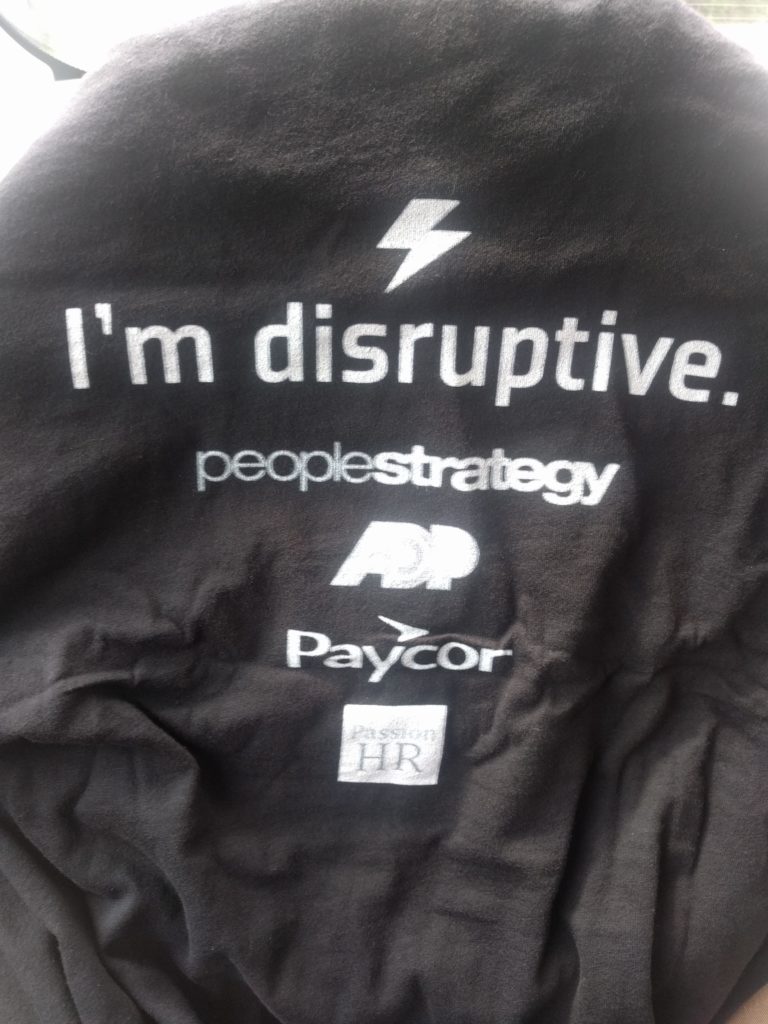
Additionally, our sponsor partners were amazing and we are so thankful they worked with us to make this event special. I like ’em so much I put their names on the special DisruptHR shirts I had made last week. :-) Thanks again PeopleStrategy, ADP, PassionHR, and Paycor! DisruptHR Shirt

This week I have a lot of great things in store for you. I’m doing some writing around compliance, investigations, and HR metrics that I am looking forward to sharing with you. Additionally, I did an interview with Collette Williamson from Southwest Airlines to uncover some of their expertise around building a great culture that I should be posting this week as well. Stay tuned for good stuff!


Article source:Ben - #DisruptHR HSV 1.0 is in the books!»

Check out more of Ben Uebanks' work at Upstart HR

Tuesday, 7 August 2018

Guest Article: What Kind of Content Can You Find at a #DisruptHR Event? by Ben

We officially sold out of our first block of 100 tickets late last week for the DisruptHR HSV event coming up on August 16th. However, thanks to a stroke of luck/providence our original space was leased out to someone else so we were bumped to a bigger room, allowing us to sell more tickets. If you’re within driving distance of Huntsville I would LOVE to see you there. We have people coming from Atlanta, Birmingham, etc. so it’s definitely worth the drive!

One of the questions I’ve received about the event is what kind of content they can expect. Well, we’re not going to give you a short list of the laws and regulations surrounding HR. We expect you to know those, and the format really isn’t conducive to that kind of approach. After all, speakers have just five minutes to make their point and get off the stage!

So, with that in mind, what kind of intriguing and thought-provoking content are we planning for this first edition of DisruptHR HSV? Here’s a taste…

  • Recruiters often look just at someone’s qualifications and skills, but they often miss the critical culture fit aspect. Humans are bad at judging this in some cases, but a ton of research shows that culture is critical in hiring. This session will show you why and how to do it better.
  • Innovation is a sought after buzzword in the business space. We need to create opportunities to help people generate new ideas in new environments. Coworking is a powerful way to do this, but some employers aren’t sure of the value or how to make it work. This session will show you how.
  • We’re so used to relying on experience as a measure of employee value, but in an era of absurdly low unemployment rates (more open jobs than unemployed individuals!), many employers are considering dropping experience requirements for some roles. This session will give you insights into how to quantify other important elements like enthusiasm and passion.
  • Have you ever thought about why people come to your city (or not)? We recruit for our companies, but cities also recruit talent and businesses with incentives, tax benefits, and local amenities. We can learn some valuable lessons from economic development professionals on how to better position our companies and regions when we’re pitching candidates to come to the local area.
  • Performance management practices are great and all, but employees and managers hate them. HR often does, too. The approach companies take literally sucks the life from them like some sort of energy vampire. But there is a better, smarter way to do it, and we want to help you get on the right path.

See? Some of this is more “traditional” HR, but with a twist. Other parts are taking a step further and encouraging us to think differently and more holistically than we would otherwise. With a total of 14 speakers, you know we’re going to get into some really interesting territory.

If you’re curious about the event, it’s just $15 to attend. We have phenomenal sponsors lined up to help with the event and they are keeping costs manageable for you to come and enjoy some good food and networking.

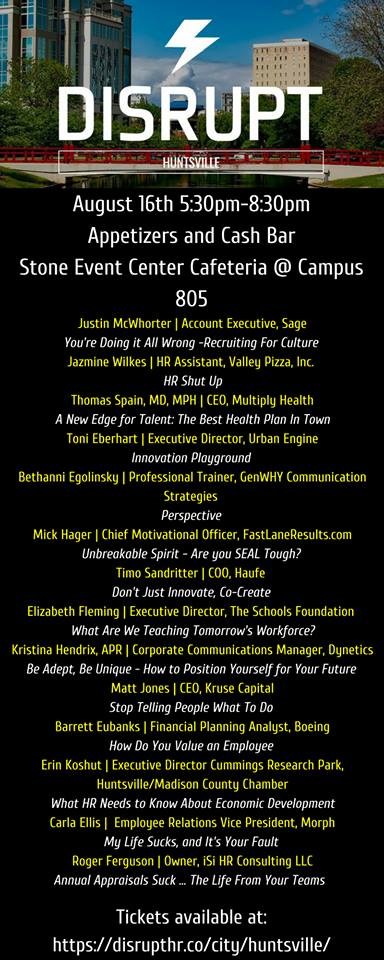
A special thank you to PeopleStrategy for being our first top-level sponsor! Also we appreciate our friends at Paycor and PassionHR for supporting the event as well as sponsor partners. We have room for one or two more sponsors, in case anyone else is looking to connect with 100+ HR leaders at the event. For the full list of speakers and topics check out the list below. I hope to see you there!

DisruptHRHSV Speaker Image


Article source:Ben - What Kind of Content Can You Find at a #DisruptHR Event?»

Check out more of Ben Uebanks' work at Upstart HR

Tuesday, 31 July 2018

Guest Article: We’re Only Human 39: Ohio Living Serves 70,000 Clients Annually with Core Values by Ben

Do you know the core values of your business? Do your employees? More importantly, do they live them?

In today’s episode, Ben interviews Dana Ullom-Vucelich, Chief Human Resources Officer and Ethics Officer at Ohio Living. Ohio Living provides services to a range of individuals, reaching more than 70,000 clients per year. The company’s 3200 employees are guided not just by policy and procedure, but by a strong sense of ethics and core values that permeate the culture and atmosphere of the firm.

In the discussion, Ullom-Vucelich gives her insights into what it takes to engage employees and get their best. In addition, she gives a variety of business and clinical/healthcare impacts of having engaged employees, going beyond the “pat on the back” to more substantial value that engagement and recognition can bring. If your business is looking for ways to create more engagement and drive better business results, this is the show for you.

Learn more: https://www.ohioliving.org

If you enjoyed this, be sure to check out episode 20: Growing a Business with Your Heart


Article source:Ben - We’re Only Human 39: Ohio Living Serves 70,000 Clients Annually with Core Values»

Check out more of Ben Uebanks' work at Upstart HR

Guest Article: PHR/SPHR Course Update [Announcement] by Ben

If you aren’t studying for the HR certification exam then feel free to ignore this or share it with someone that is studying. Thanks! :-)

Earlier this summer I set a really big goal for myself and the team that’s working on the development of the new PHR/SPHR course. I wanted to have the new course fully up and running by August 1st to coincide with the new HRCI changes. However, this is still in development and it’s looking like we will miss the deadline for rolling out the new course.

With that in mind, I’ve decided to take an intermediary step and adapt the materials we’ve been using and updating for the last 10 years to help test takers to bridge the gap. These changes should be done this week and I’ll post again letting everyone know. The changes HRCI has made are fairly minor and mostly revolve around changing the titles of the sections and moving around some of the content, but as I’ve told students for years it isn’t like HR is suddenly new and different (we just make up different names for some pieces of it on a regular basis to keep things fresh).

That said, we are still pushing the development of the new materials. I am really excited to see where this goes and would love to have a handful of beta testers to try it out for free as we finalize development in August in exchange for feedback. If you’re interested in this please reach out to me!


Article source:Ben - PHR/SPHR Course Update [Announcement]»

Check out more of Ben Uebanks' work at Upstart HR

Monday, 30 July 2018

Guest Article: Using Job Titles Instead of Pay to Compensate Employees by Ben

Writing a lot about compensation today! I also have a piece up about 3 ways compensation policies can cause employee turnover as well in case you want to check it out. . 

This past week I was talking with a friend and he explained that his job title had recently been changed from “XYZ specialist” to “XYZ manager.” He laughed and said that, of course, it didn’t come with a pay raise. I know those kinds of “promotions” are common, but I also explained to him that even if a raise didn’t come right away, having a title like that could lead to higher pay down the road.

For starters, even if there is no pay change, the recognition of your hard work with a title change can give you a sense of satisfaction with your work. Dan Pink’s book Drive talks about the three areas we need to hit in order to create an engaged workforce: autonomy, purpose, and mastery. This recognition hits squarely on the mastery piece, especially if the title change is conveyed appropriately. We want to feel like masters of our own domain, and that transition in job title can be one way of realizing that.

Perhaps even more importantly is the future potential value of that job title. If my friend was looking for a job and has “XYZ specialist” on his resume, employers and recruiters will assume he’s earning in a specific range. However, with “XYZ manager” on the resume, recruiters will assume that his range is even higher, potentially increasing job offers and opportunities. For example:

  • Specialist market range is $60k to $80k
  • Manager market range is $70k to $90k

That job title change could be worth up to $10,000, depending on how it’s leveraged in the future. This is a pretty significant bump for the receiving individual!

I do want to caution you that I am not promoting title inflation at the expense of the workforce. This isn’t about throwing titles at people that haven’t earned them or trying to avoid paying someone what they have earned by changing a few letters in their job title.

Instead, I see it as just one more tool we have to help create more connectivity between the employee and the company by recognizing their contributions. This is a one-time opportunity and can’t be used year over year to avoid paying someone for what they’ve accomplished.

What do you think? Have you done this? Would it work for some of your high performers? 


Article source:Ben - Using Job Titles Instead of Pay to Compensate Employees»

Check out more of Ben Uebanks' work at Upstart HR

Tuesday, 24 July 2018

Guest Article: Why You Should Always Discriminate in the Workplace by Ben

Discrimination isn’t necessarily a bad thing.

I overheard a conversation the other day between two employees at a local restaurant. One of them said:

“I am so sick of our boss. He is always discriminating against me for coming in a few minutes late or not getting my work done as fast as Joe.”

The second employee turned to the first and responded:

“It serves you right. Show up on time. Do better work. It’s not really that hard.”

Because I’m incredibly mature and kindhearted I held my laugh in until I was out of earshot, but it seems like I hear this kind of thing more and more. People feel like all kinds of discrimination are bad/wrong/evil.

Not true.

See, we won’t discriminate against you for your age, gender, etc. Those things are protected (as they well should be). But work performance? I can discriminate against you all day long.

“Discrimination” isn’t a blanket defense for poor work habits. Just an FYI. In the words of the young man who is wise beyond his years: show up on time and do better work. It’s not really that hard.

Share this with a friend or leader that would appreciate it today!


Article source:Ben - Why You Should Always Discriminate in the Workplace»

Check out more of Ben Uebanks' work at Upstart HR

Wednesday, 18 July 2018

Guest Article: Your Invite to #DisruptHR HSV: Let’s Do This by Ben

If you live within driving distance of of Huntsville, Alabama, I’d love to personally invite you to the first ever DisruptHR HSV on August 16th at 5:30pm. If you’re not familiar, DisruptHR is a global movement made up of local grassroots-level events giving HR and business leaders an opportunity to network and discuss how we can change HR for the better.

disrupthr hsv

We just closed the speaker applications and are sorting through submissions (announcing soon!) If you want to sponsor (limited opportunities up for grabs), contact me here. If you want to attend, tickets are very inexpensive. We purposely priced them at such a low rate to make sure we can make attendance attainable for anyone that is interested in HR, training, talent, and/or recruiting.

Kristina Minyard and I are the co-organizers (co-disruptors?) for this event, and we’re honored to have the opportunity to bring this event to Huntsville and help our local HR audience learn and grow through innovative content. There will be food. There will be drinks. There will be content. What more could you ask for?

We have a ton of amazing speakers lined up, including one of Huntsville’s finest and a nationally recognized HR blogging and social media expert, Jazmine Wilkes. Additionally, our fine city will be represented by Erin Koshut, one of the key influencers and leaders at the Huntsville Chamber of Commerce. Look for more speaker info coming out soon on the event page.

If you have questions, feel free to reach out to me. Tickets just opened last week and are already nearly 30% sold out. We fully expect to sell out in advance!


Article source:Ben - Your Invite to #DisruptHR HSV: Let’s Do This»

Check out more of Ben Uebanks' work at Upstart HR

Monday, 16 July 2018

Guest Article: Here’s How An Engaged Company Outperforms Others by Nearly 150 Percent by Ben

Employees are more disengaged than ever, and the statistics on employee engagement only serve to further the narrative. Gallup reports that more than half of employees (51 percent) say they’re actively looking for a different job or watching for opportunities. Nearly 26 percent of the U.S. workforce is going to change jobs this year, and these are typically the most highly skilled and motivated employees.

Organizations need to fully understand just how critical engagement is to success. Gallup shows that organizations with a highly engaged workforce outperform peers by 147 percent in earnings per share. And the cost of rehiring and retraining replacement workers has been well-documented.

So why, in this enlightened age, would any organization not prioritize employee engagement?

The Compliance-Engagement Balancing Act

Midsized organizations may be struggling to do more with less, which in some cases can lead them to skimp when it comes to employee engagement efforts. According to the ADP Research Institute® (ADP RI) report, “Midsized Businesses: Poised to Lose Balance in a Time of Uncertainty,” midsized businesses were spending less time focusing on talent management and significant energy on compliance. That’s because of continued concern around how compliance impacts the business. “Of all the midsized business owners surveyed, 40 percent indicate they have experienced unintended expenses as a result of non-compliance with government regulations,” reports ADP RI.

Regulatory complexity can impose additional stress on an organization’s already limited resources. This stands to reason, given the fact that midsized businesses seldom have the powerful compliance resources that large businesses do, and yet are held to the same compliance standards.

All of this comes at a time when midsized businesses are playing a greater role in the global economy. According to ADP RI, of the 16.3 million net jobs added during the last seven years, midsized businesses created 7.1 million or 44 percent of those jobs.

Making Engagement a Strategic Priority

It’s no surprise that organizations may choose to focus on compliance issues at the expense of other priorities. Yet, ignoring engagement issues is shortsighted and can lead to costly turnover. So what is a midsized business to do? The good news is that some of the most effective employee engagement initiatives don’t require dollars, they require attention. Engagement is all about motivating employees to go above and beyond, to give their discretionary effort. That comes when employees feel heard, valued and are tied to the mission of the organization.

If an employer will focus on these key areas, they can make great strides toward engaging the workforce. Conversely, if an employer misses the mark on these crucial engagement areas, it’s an excellent way to quickly lower worker satisfaction, performance and motivation.

Transparent Leadership

Creating additional layers of bureaucracy? Adding another “black box” process that the average employee can’t understand? Attempting to lead with minimal transparency will likely disengage workers, because there is no basis of trust.

More than ever, workers expect transparency in leadership. They want to feel heard and valued and know they can be trusted with information. Workers want to feel connected to their job, manager and employer. An atmosphere of mutual trust can give employees faith in leadership and help them to feel ownership in outcomes, a key component of engagement.

Growth Opportunities and Flexibility

Is your organization putting people in roles and expecting them to stay there for three years or more to “pay their dues?” If so, you’re on the track to increasing turnover and creating a negative employee experience for your team. Workers expect to be given opportunities and the tools to be successful.

Finally, creating a workplace where time sitting in a chair is more important than outcomes and performance can negatively impact engagement, especially for your best and highest-performing workers. Flexible scheduling, paid time off benefits and work-from-home opportunities can play a major role in an employee’s decision to take or leave a job.

Today business is global, hyper-connected and multigenerational. Employees really want the same thing: meaningful work and a voice in the workplace. Luckily, those things cost employers little more than putting in the time to be aware of their employees’ needs. A small price to pay for increased engagement and performance from the organization’s most precious resource.

Originally appeared on the ADP Spark blog: https://ift.tt/2LlmtE8


Article source:Ben - Here’s How An Engaged Company Outperforms Others by Nearly 150 Percent»

Check out more of Ben Uebanks' work at Upstart HR