February is Black History Month and consistent with the last few years that I’ve been a blogger, this Black History month I was stuck on what to write. Like many, I want to show my support, especially in our current political environment but wasn’t sure quite what that support looked like. On the advice of […]
Article source:Melissa Fairman - Supporting Black History Month»
Check out more of Melissa Fairman's work at HR Remix

Thank-you to all of our regular readers of the blog!
If we can assist you in any way please do not hesitate to get in touch at http://www.psychpress.com.au, or contact us at info@psychpress.com.au
Thursday, 22 February 2018

Wednesday, 21 February 2018
Guest Article: Blessings by Jay Kuhns, SPHR
I'm not sure if you've noticed or not, but there is a heck of a lot of negativity in the world today. Political leaders don't talk to each other anymore, they simply retreat to the safety of their extreme left, or extreme right news networks and gripe about each other.
Often the world of work is no different. I hear the cries to be different, to embrace innovation, and to be more progressive. Then all of the close-minded biases raise their ugly heads and the organization (and it's people) suffer.
Work Blessings
As I reflect on the polarized world we live in, it strikes me that I have an awful lot to be thankful for in spite of all the noise. It's too easy to fall into the trap that everything around us is "bad."
That's simply not true.
While I may be repulsed at the behavior of our political leaders, I certainly have other leaders in my life who are nothing short of world-class. I work with a team of people who are committed to doing their best work every day...and it shows...as the results of their work has allowed my company to grow at a dramatic rate.
Personal Blessings
 I am blessed with three incredible children, an amazing family, and close relationships that I wouldn't trade for anything.
I am a bit of a fitness junkie, and have discovered a passion for healthy eating and daily workouts that not only help me keep pace with my busy life, but help me feel great too.
The church I joined is an open, welcoming community of faith the treats every person with respect, no matter what their background or experiences may be.
Lastly, I live in a part of the world that can only be described as paradise.
How About You
Today I'm going to let all the folks caught up in their miserable, negative existence stay right where they are. There's no room for them. I'm too busy focusing on the incredible blessings all around me.
What blessings have you overlooked?
I'd love to hear from you.
No Excuses.
Article source:Jay Kuhns, SPHR - Blessings»
Check out more of Jay Kuhns' work at No Excuses HR
Often the world of work is no different. I hear the cries to be different, to embrace innovation, and to be more progressive. Then all of the close-minded biases raise their ugly heads and the organization (and it's people) suffer.
Work Blessings
As I reflect on the polarized world we live in, it strikes me that I have an awful lot to be thankful for in spite of all the noise. It's too easy to fall into the trap that everything around us is "bad."
That's simply not true.
While I may be repulsed at the behavior of our political leaders, I certainly have other leaders in my life who are nothing short of world-class. I work with a team of people who are committed to doing their best work every day...and it shows...as the results of their work has allowed my company to grow at a dramatic rate.
Personal Blessings
 I am blessed with three incredible children, an amazing family, and close relationships that I wouldn't trade for anything.
I am a bit of a fitness junkie, and have discovered a passion for healthy eating and daily workouts that not only help me keep pace with my busy life, but help me feel great too.
The church I joined is an open, welcoming community of faith the treats every person with respect, no matter what their background or experiences may be.
Lastly, I live in a part of the world that can only be described as paradise.
How About You
Today I'm going to let all the folks caught up in their miserable, negative existence stay right where they are. There's no room for them. I'm too busy focusing on the incredible blessings all around me.
What blessings have you overlooked?
I'd love to hear from you.
No Excuses.
Article source:Jay Kuhns, SPHR - Blessings»
Check out more of Jay Kuhns' work at No Excuses HR
Monday, 19 February 2018
Guest Article: How Does AlliedUniversal Hire 90,000 Workers a Year? Referrals and PURPOSE [Podcast] by Ben
How many people did your firm hire last year? 10? 100? 1,000? While it’s not a contest, there are lessons to be learned from organizations that hire more people, because they have the process down to a science. Today we’re going to hear from the head of hiring operations at AlliedUniversal, one of the largest security firms in the world. AlliedUniversal hires more than 90,000 workers per year and has some great lessons we can all learn from, such as hiring with purpose.
I actually looked at the archive and realized I recorded a video nearly 8 years ago on how to work with purpose. It’s pretty early in my video recording days, which means the quality is iffy and you get to see the version of me that was brand new to this whole world of HR, but if you want to subject yourself to it, here’s the link. :-)
Subscribers click through to listen to the show below
 Show Link:
 Show Notes
How does something as seemingly simple as purpose fit into a company’s hiring plans, especially when those plans involve hiring more than 90,000 people a year? That’s a core part of the conversation when Ben recently connected with Catherine King, VP of Talent Acquisition and Staffing at AlliedUniversal. The company is an impressive security services firm with 150,000 employees spanning the United States and serving in a variety of industries.
The company also uses some interesting referral bonuses to help drive new hires, but not the way you might expect. Instead of relying just on an internal referral program like most firms, AlliedUniversal actually pays community organizations such as AARP for every single referral that is ultimately hired, drastically increasing the reach and talent pool. The company makes a special effort to hire senior, or experienced, workers as they bring a wealth of experience to the communities in which they serve.
In the discussion, Ben and Catherine delve into these talent strategies along with other aspects of how AlliedUniversal fills critical roles by giving employees a sense of a greater purpose. It’s a great conversation and one that you don’t want to miss!
To learn more about AlliedUniversal’s referral program, visit http://www.aus.com/pie
This episode is sponsored by WorkHuman.com


Article source:Ben - How Does AlliedUniversal Hire 90,000 Workers a Year? Referrals and PURPOSE [Podcast]»
Check out more of Ben Uebanks' work at Upstart HR
Guest Article: Renewing Your Leadership Purpose with Compassion by Jennifer Miller

Years ago, when I was a 23 year old assistant human resources manager at a department store, one of our sales associates suffered a heart attack and died while at work. At the time, I was out of town, attending my grandfather’s funeral. Upon my return to work, my boss Mary told me what had happened and carefully gauged my reaction. She was concerned about me suffering two losses in quick succession. When I assured her I was OK, she asked me to check in with Scott, the department manager of the gentleman who had died. Scott had also experienced two recent losses: the death of his mother just a month before the passing of his co-worker. Mary thought it would be helpful for me to talk with Scott because we were the same age and socialized outside of work.
Later that day, as Scott walked into my office, I thought, “What in the world can I possibly say to this man that will help him?” There we were, two young people trying to figure out how to navigate a fast-paced work environment that, frankly, required us to “get on with it.” In the end, I settled for a simple, direct approach. I asked Scott how he was doing, offered my support and then settled in to simply “be” with him in silence for a few moments of acknowledged sadness. Given my inexperience in such matters, it was the best I could offer in the form of compassion but it seemed to suffice.
Suffering has a way of creeping into even the most benign of workplaces. And leaders are in a unique position to, “both create and alleviate suffering,” write authors Monica Worline and Jane Dutton in the book “Awakening Compassion at Work.” Worline and Dutton have researched the topic of compassion in the workplace and conclude that, unlike the positive psychology concepts of gratitude and happiness, compassion is an interpersonal concept that is linked to the darker side of the human experience. “Compassion goes hand-in-hand with suffering,” the authors write. Even though the topic of suffering is a heavy one, Worline and Dutton point out a positive element: the chance for leaders to renew themselves through the display of compassion.
Breaking the Cycle of Continual Leadership Stress
Leadership is fraught with the stress of daily decisions and competing priorities. In the article “Mindfulness, Hope and Compassion: A Leader’s Road Map to Renewal,” authors Annie McKee, Frances Johnston and Richard Massimilian put forth the concept of learning to manage the leadership cycle of “sacrifice and renewal.” They write that, “leaders cannot sustain their effectiveness if they cannot sustain themselves. Leaders must deal with ‘power stress’ caused by a combination of responsibility, constant self-control and the inevitable crises, both small and large that the leadership role demands.” Failing to do so causes what McKee, et al. call “Sacrifice Syndrome,” a cycle that leads to continued stress and eventual burnout. One way to help break the cycle is to exhibit compassion, which rests on caring about others in a profound way. Doing so puts the focus on someone else, which allows you to set aside your problems for the moment. I certainly found this to be true when I sat down with Scott to ask him how he was doing after the sad events that had in my own life.
The Unexpected Benefit of Compassion in Business
Compassion can exist within the business environment. McKee and her colleagues see an unlikely connection to a key business skill: inquisitiveness. They write that leadership compassion springs from a natural source. “Compassion is natural. Why? Because compassion starts with curiosity about other people, what motivates them and how the world outside of our own actually works.” This curiosity–to know someone not because of the salacious details we might glean, but to genuinely walk alongside them in their time of suffering–is what makes a great leader. “Generosity grows for the suffering that may sometimes make work life messy and difficult. Leading with compassion restores our belief in a better future so that we can feel our way forward together,” offer Worline and Dutton.
The Power of Tuning In
You may have heard the phrase, “Are you a human being or a human doing?” Far from just another thing on your To Do list, dialing in to others can actually help renew your energy and refocus on your leadership purpose. “To lead with compassion requires that leaders weave more attention to the full human state of others into their work relationships” write Worline and Dutton. Tuning in to someone requires you to simply “be” in the moment, hearing what someone is saying. Observing for what they are “saying” with their body language, but not their words. Intuiting for the right words of comfort to offer. This is the approach I took with my colleague Scott. After a couple of minutes of conversation, it was clear he did not wish to explore his sadness while at work, so I settled for a few brief words of support and let it go at that.
All humans experience suffering. We can’t expect the pain to conveniently check itself at the door when employees arrive at work. Compassion isn’t the easiest of emotions to display for some, but demonstrating care for a person who’s suffering elevates a person from “manager” to “leader.”
Who is suffering today, and how will you care for them? How will you renew yourself through compassion?
A modified version of this article appeared as a SmartBrief Original and is reprinted with permission.

Article source:Jennifer Miller - Renewing Your Leadership Purpose with Compassion»
Saturday, 17 February 2018
Guest Article: The Inability to Respond by Jay Kuhns, SPHR
As Human Resources leaders, we care deeply about leadership competencies in two ways:
- The first, is putting forth the effort to identify, develop, and implement them.
- The second, which is BY FAR the one we immediately forget, is to hold our leaders accountable to live up to those competencies.
Things Happen
Every day we're challenged as unexpected circumstances arise. These aren't necessarily 'bad things' but they do require attention. Our attention.
For example...new initiatives are planned and launched...milestones must not only be met, but a significant amount of effort must go into reaching those milestones on schedule...
But somehow, things aren't moving along as they should.
Another example...outdated policies and practices are identified that no longer make sense (think anything your organization has written relative to social media, employer brand strategies, or sharing content)...yet, somehow, no one ever gets around to being courageous enough to challenge the old-school thinking in the compliance department...
So yet again, things aren't moving along as they should.
Not Unwilling...Just Unable
Back to leadership competencies. We write them. We agonize over the exact words that will represent what our organization values most in our leaders. We roll them out through training and communication plans, and ultimately integrate them into job descriptions.
Why then, after all of that effort, do we allow leaders to avoid living up to them? How is it that so much high quality work can be so quickly squandered when "leaders" appear to choose not to follow through and execute?
 I submit that it is for one simple reason. It's not that they don't want to do the hard work. I am convinced more than ever, that many leaders simply can not do it.
The over-inflated arrogance they carry with them consistently crashes and burns for all to see when projects do not move forward.
They can not respond to the challenge, and when leaders are unable, they no longer deserve to serve in that role.
Harsh? Honestly friends, I don't think so.
How About You
Take a look at your leaders, and compare their behavior with the leadership competencies you've committed to as an organization. Who consistently misses the mark, despite intervention, support, and 'fresh starts?'
Something to think about.
I'd love to hear from you.
No Excuses.
pic
Article source:Jay Kuhns, SPHR - The Inability to Respond»
Check out more of Jay Kuhns' work at No Excuses HR
- The first, is putting forth the effort to identify, develop, and implement them.
- The second, which is BY FAR the one we immediately forget, is to hold our leaders accountable to live up to those competencies.
Things Happen
Every day we're challenged as unexpected circumstances arise. These aren't necessarily 'bad things' but they do require attention. Our attention.
For example...new initiatives are planned and launched...milestones must not only be met, but a significant amount of effort must go into reaching those milestones on schedule...
But somehow, things aren't moving along as they should.
Another example...outdated policies and practices are identified that no longer make sense (think anything your organization has written relative to social media, employer brand strategies, or sharing content)...yet, somehow, no one ever gets around to being courageous enough to challenge the old-school thinking in the compliance department...
So yet again, things aren't moving along as they should.
Not Unwilling...Just Unable
Back to leadership competencies. We write them. We agonize over the exact words that will represent what our organization values most in our leaders. We roll them out through training and communication plans, and ultimately integrate them into job descriptions.
Why then, after all of that effort, do we allow leaders to avoid living up to them? How is it that so much high quality work can be so quickly squandered when "leaders" appear to choose not to follow through and execute?
 I submit that it is for one simple reason. It's not that they don't want to do the hard work. I am convinced more than ever, that many leaders simply can not do it.
 The over-inflated arrogance they carry with them consistently crashes and burns for all to see when projects do not move forward.
They can not respond to the challenge, and when leaders are unable, they no longer deserve to serve in that role.
Harsh? Honestly friends, I don't think so.
How About You
Take a look at your leaders, and compare their behavior with the leadership competencies you've committed to as an organization. Who consistently misses the mark, despite intervention, support, and 'fresh starts?'
Something to think about.
I'd love to hear from you.
No Excuses.
pic
Article source:Jay Kuhns, SPHR - The Inability to Respond»
Check out more of Jay Kuhns' work at No Excuses HR
Thursday, 15 February 2018
Guest Article: Mini Virtual HR Conference: HR Metrics and Change Management (2 Free Business Credits) by Ben
In the last few weeks I’ve had the pleasure of visiting Toronto and the Caribbean to speak about metrics, evidence, and leading change. It’s been wonderful to speak to hundreds of HR pros between the two events, but I also realize that many of you are looking for quality content and conversations to improve your own HR service delivery.
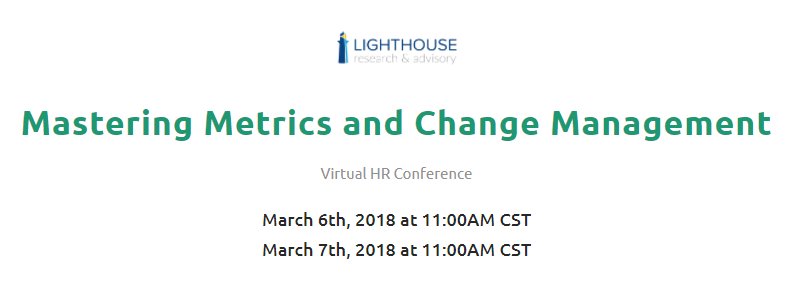 With that in mind, I’m going to run a mini virtual HR conference at 11am Central time on February 20th and 21st. Here’s the schedule:
- Tuesday, March 6th Metrics: Measuring HR’s Business Value
- Wednesday, Marcy 7th Driving Change: How HR Can Lead Effective Change Management Practices
These sessions have been previously approved for business credits from HRCI and general professional development credits from SHRM.
If you’re interested in attending, you can register below or on our registration page:
Register for the event
Session Descriptions
Session 1: Metrics: Measuring HR’s Business Value
“If it can’t be measured, don’t do it.” This quote from a conversation with a CEO of a global enterprise has a powerful ring to it — but do we really have the ability to measure everything that we do in the business? This session is designed to help HR leaders understand how to create a measurement mindset that looks first to data to help solve organizational problems. Explore examples of balanced scorecards and unique metrics created to align with business objectives, as well as case studies of metrics in action. Find out how to develop an evidence-based approach to solving business problems.
Session 2: Leading Change: How HR Can Lead Effective Change Management Practices
Change, funny enough, is unchanging. Every day there are new challenges and opportunities, but are our organizations ready for this pace? In this lively session, Ben Eubanks will examine the increasing pace of change for the business world and what it means for those tasked with internal change management practices. Are the old methods still enough, or do we need a new model? In addition, we’ll explore principles of influence, such as building alliances, considering stakeholder inputs, and more. The session will include case studies of companies that have successfully (and unsuccessfully) faced change head-on and the lessons found within.
Register for the event
FYI: This workshop has previously been pre-approved for 3 hours of business credits with HRCI (3 SHRM PDC’s). Contact me for details if you’re interested in having this session delivered to your local SHRM chapter or HR group,
If you missed seeing me these last few weeks on the road, I’d love to have you join me!


Article source:Ben - Mini Virtual HR Conference: HR Metrics and Change Management (2 Free Business Credits)»
Check out more of Ben Uebanks' work at Upstart HR
Wednesday, 14 February 2018
Guest Article: Real-World Ideas for Developing Your Team by Jennifer Miller

What does internal career mobility look like at your company? Maybe it’s a fancy program spearheaded by your HR or talent development team. Or maybe it’s a boot strap operation with limited funding. Providing your employees with “career mobility” inside your organization starts with you, the leader, providing professional development opportunities.
No development dollars, you say?
No problem. I checked in with three resourceful leaders who make professional growth a priority. And they do it on a shoe string budget. Go check out my latest SmartBrief contribution with No development budget? Internal career mobility is still within your reach, which chronicles specific ideas for how to help your staff grow professionally, even if time and dollars are limited.

Article source:Jennifer Miller - Real-World Ideas for Developing Your Team»
Subscribe to:
Posts (Atom)