Tuesday, 27 March 2018

Guest Article: How to Get the Employee Experience on the CEO’s Agenda [eBook+Webinar] by Ben

employee experience business impact
Short version: I’m co-hosting an upcoming webinar focusing on the employee experience and how to get executive attention and investment in building your own firm’s employee experience. Read on for details about how to sign up and how to get a free copy of the new eBook!

It’s hard to turn around today without hearing about the employee experience. Virtually every vendor is laying claim to this concept, yet for most HR practitioners the concept is fuzzy, and for executives, it’s even more abstract. In that case, good luck getting support and investment for yet another “squishy” HR program that doesn’t impact the business… Seriously though, what is this idea of the employee experience, and more importantly, does it connect to the business in a meaningful way?

This question is the one my HR Federation partners, George LaRocque and Madeline Laurano, and I set out to answer. George and I will be leading a webinar on March 29th at noon Central to explore the concepts in the eBook and to dig a little deeper into the employee experience. It will be a fun conversation full of ideas to help you up your HR game. Be sure to register here for the session so you can get those insights. In addition, we’ll be giving registrants a copy of the eBook for free!

About the eBook

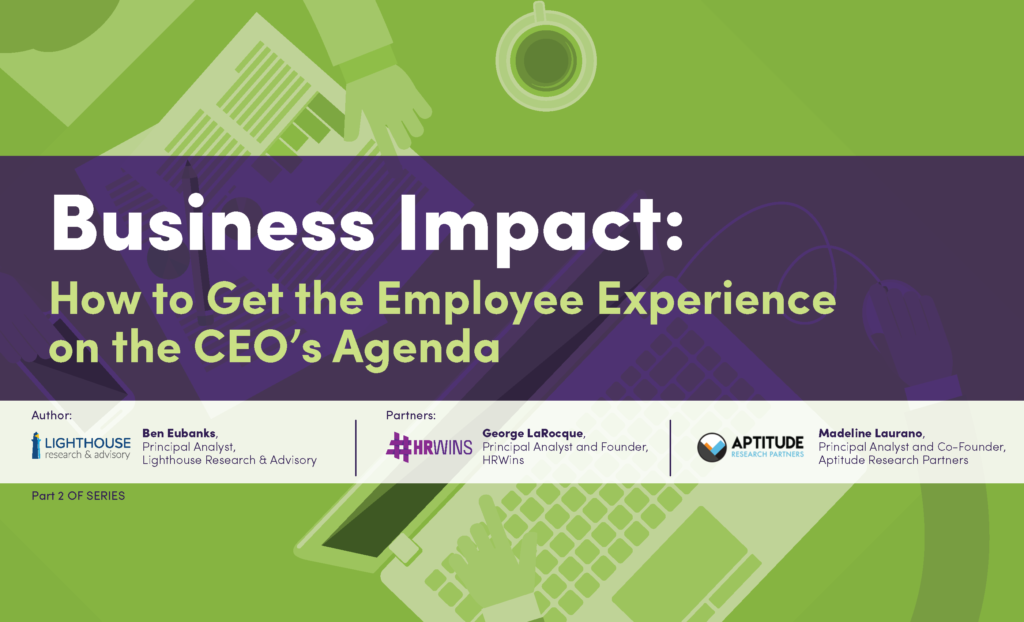
Our latest collaborative piece adds some much needed clarity around the concept of employee engagement. The eBook specifically looks at how to get the employee experience on the CEO’s agenda.

In the eBook, you can learn about how to connect key business metrics, such as innovation, revenue, productivity, customer satisfaction, and employee retention, back to this overall concept of employee experience. As any leader knows, having an executive-level discussion about the business will inevitably turn back to the data, and this guide arms you with specific examples to help build a business case for embracing and investing in the employee experience.

In addition, if you have questions about the employee experience (what is it, how does it work, why should you care, etc.), feel free to bring those to the discussion Thursday and George and I can address them in the flow of the conversation.


Article source:Ben - How to Get the Employee Experience on the CEO’s Agenda [eBook+Webinar]»

Check out more of Ben Uebanks' work at Upstart HR

Friday, 23 March 2018

Guest Article: This Is Not the Edge of the World by Jay Kuhns, SPHR

The rollercoaster world of work is...

exhausting.
exhilarating.
maddening.
exciting.
frustrating.
rewarding.
the worst.
the best.

No matter what it is for you today, remember you're not living on the edge of your world. It's just the thrill of the ride. Hang on tight in good times and bad, and embrace every minute.

I'd love to hear from you.

No Excuses.

pic
Article source:Jay Kuhns, SPHR - This Is Not the Edge of the World»

Check out more of Jay Kuhns' work at No Excuses HR

Tuesday, 20 March 2018

Guest Article: Developing Internal Blogging Teams by Jay Kuhns, SPHR

So, you've finally decided to execute on a robust employer brand strategy. Your career site is actually a real site, not just a job list, you're pushing content several times a week and distributing it across multiple dedicated HR social channels.

Well done!

But you're still missing out on a great recruitment, retention and recognition opportunity.

Our People...Our Most Important Asset
So many leaders talk about how important their people are, yet I rarely see those same "important" people writing about their experiences at work. 

We tell stories about them, that is a cornerstone of any good plan. However, when was the last time you saw the actual employees telling their own story?

It's not as risky as you might think

Plan...then Execute
There are several basic steps that will serve as the foundation of your internal blogging team structure.

1 - Identify several employees who have an interest in building their brand, supporting the organization, and aren't shy! Align the team members with your organizational needs (recruitment, expansion, growth.)

How do you find them? Ask!

2 - Meet with the employees and describe your goals, do's and don'ts, and reinforce that they are not uploading content, formatting, or publishing. HR handles all of those pieces. They simply need to send an email "post" to you each month.

How do I support them? Stay connected, meet for coffee, and talk through their challenges!

3 - Make sure your bloggers have up to date LinkedIn profiles, twitter accounts, and hopefully, Instagram accounts as well. If you're going to be a blogger...you need to be in the social media space!

How do I make sure this happens? Meet with them and get them set up on the spot!

How About You
I've had tremendous success using this strategy, and you can too! It doesn't matter if you're a blogger or not. The goal is to differentiate your organization from the competition. Additional benefits include helping you to create a culture that truly recognizes and showcases your employees! Now, what are you waiting for?

I'd love to hear from you.

No Excuses.


Article source:Jay Kuhns, SPHR - Developing Internal Blogging Teams»

Check out more of Jay Kuhns' work at No Excuses HR

Monday, 19 March 2018

Guest Article: How to Attend an HR Conference (and make it worth your while) [Podcast] by Ben

One of the greatest compliments I get from you, the listener, is when I have the opportunity to share something highly practical with you that you can use to improve your results in a powerful way. Today’s discussion is one of those.

Think about the last conference you attended. What did you learn?

No, specifically, what did you learn?

Research tells us that within a few days we forget most of what we hear in a single training session, much less a whole conference with a wide range of topics. That’s why today’s episode is focused on how to get the most out of the HR conferences you attend. Over the course of my ten-year career I have attended dozens of conferences, seminars, and events, and I would imagine you also attend a good number of events as well. Let’s get the most out of those, shall we?

Show Notes

Direct episode link: https://beneubanks.podbean.com/e/were-only-human-how-to-make-the-most-hr-conference/

donna quinneyFor this episode, I had the opportunity to catch up with my friend and fellow Huntsville resident, Donna Quinney, about how she plans in advance for the content to consume and the best way to make it applicable when she returns to work. The specific example we discuss is how to get the most out of a user conference, because you’re often there for double reasons: not only to learn, but usually also to bring some of those learning points back to teach the rest of the team.

All in all, a highly practical episode with ideas that any of us could put into practice starting today. Fun stuff!

In addition, we talk about a workshop I’m running at the upcoming SilkRoad Connections Conference. I hope you enjoy my discussion with Donna and if you’re going to be at SilkRoad Connections this year, I hope you plan on setting aside some time for the workshop I’m running. Enjoy the show!

Connect with Donna: https://www.linkedin.com/in/donna-q-6563a439/ 

Join me April 29th to May 2nd for SilkRoad Connections 2018 in San Antonio.


Article source:Ben - How to Attend an HR Conference (and make it worth your while) [Podcast]»

Check out more of Ben Uebanks' work at Upstart HR

Thursday, 15 March 2018

Guest Article: #UltiConnect 2018: AI Means HR Can Be More Human by Ben


perspectives ultimateThis week I spent some time at the Ultimate Connections conference in Las Vegas with the team from Ultimate Software (Twitter stream here). There were tons of product updates and great sessions, but one of the biggest takeaways for me was around AI and what it takes to build a great workplace.

During a recent event I was speaking with someone and she mentioned Ultimate Software. I said I knew the company, and her response shocked me. She said, “I wish I could…” And my brain jumped to the conclusion: “I wish I could get that software.”

However, her response was something else! She said, “I wish I could work there.” That, in a nutshell, embodies what Ultimate is all about. The firm is known within the HR community as a great place to work, has won virtually every award you’ve ever heard of (and probably some you haven’t), and has some pretty astounding Glassdoor reviews.

I mention this because the leadership at Ultimate gets what it takes to build a great company, and if you’re going to be selling software and offering advice to employers on how to build their own great culture, then there’s something to be said for having that squared away on your own side of the equation.

Back to the conversation at hand—Ultimate’s team sees AI not as a way to replace HR leaders and practitioners. The mission always has been and always will be “people first,” yet the constant barrage we get from news headlines tells us that all of our jobs are on the line thanks to robots and algorithms. The message Ultimate shares is the one that is a core focus area of my upcoming book on Artificial Intelligence for HR leaders.

AI can help us to be more human, not less.

The Need for AI to Change HR’s Current State

In your day to day, you probably spend a lot of time doing non-interactive tasks with systems and databases instead of interacting with people. It’s a challenge faced by HR teams everywhere.

The promise of AI is that we’ll be able to offload more and more of those administrative tasks in order to have time, energy, and attention to focus on those essential human tasks of collaborating, coaching, and influencing others. This is the ultimate (pun!) value that AI can offer and it’s the vision shared by the team at Ultimate Software.

To take it to a more practical level, because many of the conversations about artificial intelligence today are more theory than applicability, Ultimate’s system enables contextual help and advice for leaders, real-time analysis into employee sentiment, and more to really help HR leaders drive strategic decisions and actions at unprecedented levels.

It’s exciting to see the work that Ultimate has done to establish a foothold in this area and serve customers at the forefront of the AI adoption curve. It’s an exciting time to be in HR!

I’m honored to have had the chance to spend some time with Ultimate Software and their customers (raving fans) and thank them for inviting me to their event! 


Article source:Ben - #UltiConnect 2018: AI Means HR Can Be More Human»

Check out more of Ben Uebanks' work at Upstart HR

Tuesday, 13 March 2018

Guest Article: I Saw, Today by Jay Kuhns, SPHR

I saw commitment today.

I saw dedication to patients.

I saw a team completely focused on a goal.

I saw preparation.

I saw real-time accountability.
I saw transparency.
I saw energy.

I saw follow through.

I saw transparency.

I saw communication.

I saw passion.

I saw priorities.

I saw teamwork.

I saw action.

I saw results.

How About You
What did you see today?

I'd love to hear from you.


No Excuses.

pic
Article source:Jay Kuhns, SPHR - I Saw, Today»

Check out more of Jay Kuhns' work at No Excuses HR

Guest Article: Lead Like a Human, Not a Manager by Jennifer Miller

In today’s fast-paced world of business is it possible to bring humanity back to leadership? A new book backed by research and co-authored by a Harvard Business Review contributor aims to answer that question for you.

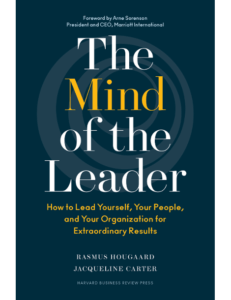
In The Mind of the Leader: How to Lead Yourself, Your People, and Your Organization for Extraordinary Results, authors Rasmus Hougaard and Jacqueline Carter offer a simple, yet compelling thesis for what makes a strong leader: it all starts within. Although the premise isn’t new, what makes this leadership book fresh is the amount of research that went into backing up their claim that it’s the internal workings of a leader’s mind that drives their effectiveness.

Hougaard and Carter write that three core mental qualities–Mindfulness, Selflessness and Compassion– form the foundation upon which leadership effectiveness is built. The Mind of a Leader draws upon an extensive literature review of neuroscience, psychology and organizational theory, and assessments of over 35,000 leaders from over a hundred countries.

The book lays out its central theme very well: As human beings we are all driven by basic needs for meaning, happiness, human connectedness and a desire to contribute positively to society. When leaders respond to these human needs with mindfulness, selflessness and compassion, they set the stage for a more productive work environment where all people feel energized and valued for their contributions.

How The Mind of the Leader Was Born

I first learned of Hougaard’s work with mindfulness during his presentation at the 2016 WorkHuman conference. Since then, I’ve followed his research with interest. Along the way, I met his colleague Jacqueline Carter. Both work for Potential Project and have extensive backgrounds in organizational and leadership development.

I wondered how the writing team moved from the topic of “mindfulness” to a broader, three-pronged approach to leadership. I reached out to the authors and here’s what I learned:

For over the past decade, Hougaard and Carter, along with their colleagues at Potential Project, had been helping leaders and organizations enhance performance with mindfulness. In recent years, they noticed that as important as mindfulness is for leaders, it wasn’t enough. Through their interviews and research, Hougaard and Carter identified additional qualities as core to enabling greater engagement, creativity and performance.

Here’s how Carter sums up the three elements of their leadership model: “To be successful today, leaders must be mindful – being present and attentive to their people’s needs; selfless – to model cultures based on growth and learning instead of ego; and compassionate – to show their people they have their back.”

In the LinkedIn article, How Leaders Must Lead for a Hard Future, Hougaard puts it this way: In a rapidly changing world, with hard challenges coming our way, we need leaders with minds who can respond mindfully, with selfless confidence and wise compassion.

Practical Tips for Leading Yourself, Your People and Your Organization

One of the best things about this book is the authors take what some view as “soft” topics and give concrete examples of how these ideas play out with real-life leaders. Not only are the excellent examples from a wide selection of industries and companies, the Hougaard and Carter also offer instructional “training” sections and “quick tips” for each segment of the book.

My Recommendation for The Mind of the Leader

This book is well-written, flows logically and provides excellent real-life examples of how to employ the three “core mental attributes” in a business context. For those who respond well to visual depictions, each of the three key sections has a corresponding matrix to help the reader ground themself in the concept. Although this book is written for those in leadership positions, the “tips” and “practices” suggested would be helpful for anyone wanting to become a more well-rounded individual capable of dealing with life’s stresses.

To learn more about this book, visit the book’s page at Potential Project.   Hint: if you scroll down the page, there is a video presentation that Rasmus made at WorkHuman 2017. It’s an excellent overview of the three key mental attributes of mindfulness, selflessness and compassion.


Disclosure: I received an advance copy of the book for the purposes of writing this review. Some of the links are affiliate links. Please form your own opinion about the materials I review on my website. Just because I liked it, doesn’t mean that you will.


Article source:Jennifer Miller - Lead Like a Human, Not a Manager»