Showing posts with label job demands and resources model. Show all posts

Thursday, 2 June 2016

How to manage your job demands and resources!

Feeling stressed? Overwhelmed? Or just unsure about what your role entails? You could be feeling this way because the demands of your job are high, but the resources you have access to are low. No wonder you might sometimes feel it is hard to do your job effectively! Understanding the various factors which lead you to feeling stressed will help you to become more self-aware and insightful about the certain things within your job which create negative feelings. This is very important! If we can acknowledge and hone in on the specific factors which make our jobs more challenging, it gives us a better opportunity to come up with targeted strategies to help improve these stressors and also means we are better prepared for a conversation with our superiors if we need help managing these challenges. 


The Job Demands-Resources (JD-R) model can be used to predict employee burnout and engagement, and consequently organisational performance.The central assumption of the JD-R model is that job strain develops – irrespective of the type of job or occupation – when (certain) job demands are high and when (certain) job resources are limited. See the diagram below for examples of job demands and job resources and how they can negatively lead to exhaustion (health-impairment process) and disengagement (motivational process).
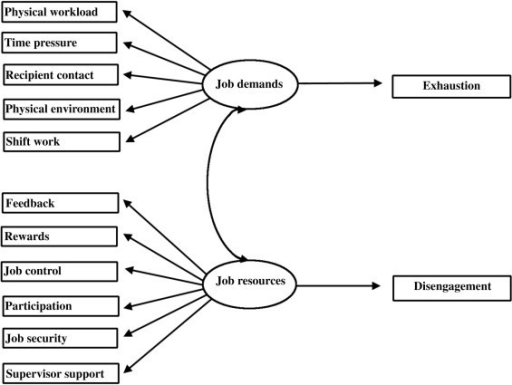


Finding the balance between job demands and appropriate resources can be a challenge for organisations and for employees. For organisations to elicit the best performance from their employees, it is important to provide appropriate resources for employees so that job demands are maintained at level which does not create extra stress or pressure. For employees, it is important to identify what types of job demands can elicit feelings of stress and to combat these negative feelings using evidence-based health and well-being strategies such as mindfulness, exercise, maintaining a healthy diet and getting enough sleep. In other words- keep striving for the sometimes elusive work-life balance!
  

Monday, 20 July 2015

Balancing Job Demands and Job Resources

Psychology research has made great headway in relation to uncovering the factors that influence
the interplay between job resources and job demands. However, finding a practical balance between the two within your workplace is often quite challenging. This article aims to introduce you to the various factors that may come into play if you are feeling stress within your workplace. Stress within the workplace is often attributed to high demands and low resources.

Bakker and Leiter in 2010 drew up a model of how demands and resources interplay and the effect they have on engagement and stress. The most popular model at the moment is the Jobs Demands Resources (JDR) Model, which highlights the following relevant factors:

Job Demands:

  • Increased workload beyond what might be reasonably completed
  • Role Conflict - when conflicts arise between the multiple roles that have to be filled
  • When there is a low amount of resilience in terms of handling change
  • Role Ambiguity
  • Work pressures from employees or managers internal to the business or, customers and clients externally
  • Emotional demands – this is particularly relevant to Allied Health as we work so closely with individuals, especially when they are requiring assistance
  • Mental demands – this relates to when the role is mentally exhausting and there is an inability to have rest break
  • Physically demanding work

Job Resources:

  • Increasing the amount of social support
  • Seek extra feedback, specifically relating to your work, but also your general behaviour in the workplace
  • Increasing the amount of supervisory coaching that you are receiving or rather putting a slightly different spin when you request feedback
  • Increasing the amount of autonomy or control you have in your job
  • Finding ways to increase your optimism within the workplace whether this be through increasing the social aspects of your work or taking a needed break
  • Increasing your competence in the role – this may be through seeking extra training or gaining clarity about your role

Reducing the amount of job demands and increasing the amount of job resources has been shown to have a positive impact on:

  • Mental and physical health factors which decreases the likelihood of energy depletion and burnout
  • Motivational factors
  • Levels of engagement
  • Increased job satisfaction
  • Overall happiness and levels of enjoyment

If managing stress in the workplace is something you would like to know more about, we recently wrote an article on Mindfulness in the Workplace, which you may find useful. You can read more about that here