Showing posts with label employee advice. Show all posts

Thursday, 2 June 2016

How to manage your job demands and resources!

Feeling stressed? Overwhelmed? Or just unsure about what your role entails? You could be feeling this way because the demands of your job are high, but the resources you have access to are low. No wonder you might sometimes feel it is hard to do your job effectively! Understanding the various factors which lead you to feeling stressed will help you to become more self-aware and insightful about the certain things within your job which create negative feelings. This is very important! If we can acknowledge and hone in on the specific factors which make our jobs more challenging, it gives us a better opportunity to come up with targeted strategies to help improve these stressors and also means we are better prepared for a conversation with our superiors if we need help managing these challenges. 


The Job Demands-Resources (JD-R) model can be used to predict employee burnout and engagement, and consequently organisational performance.The central assumption of the JD-R model is that job strain develops – irrespective of the type of job or occupation – when (certain) job demands are high and when (certain) job resources are limited. See the diagram below for examples of job demands and job resources and how they can negatively lead to exhaustion (health-impairment process) and disengagement (motivational process).
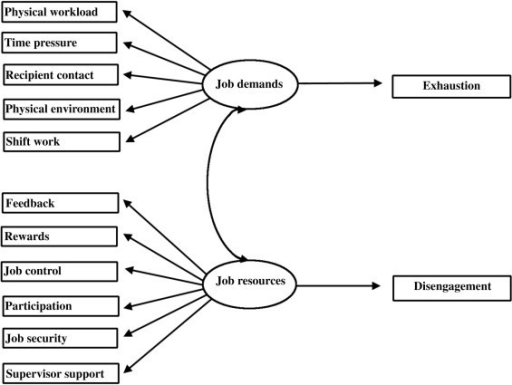


Finding the balance between job demands and appropriate resources can be a challenge for organisations and for employees. For organisations to elicit the best performance from their employees, it is important to provide appropriate resources for employees so that job demands are maintained at level which does not create extra stress or pressure. For employees, it is important to identify what types of job demands can elicit feelings of stress and to combat these negative feelings using evidence-based health and well-being strategies such as mindfulness, exercise, maintaining a healthy diet and getting enough sleep. In other words- keep striving for the sometimes elusive work-life balance!
  

Thursday, 19 May 2016

Stop! Read this before accepting a new job!

Many of us have experienced the feeling of utter relief and happiness when after a period of job hunting we are finally offered a position. For many of us, in our desperation for a new position we choose to ignore the red flags our potential employers may be holding up. When offered a new position, it is our natural inclination to accept. Take a step back for just a moment and remind yourself that most of our waking lives are spent at work. Given this, just like you would before investing in a new car or house, we should read the fine print of our work contracts and do some research before signing on the dotted line!


First thing first- ask questions! You are completely entitled to ask important questions such as “what is a typical workday like?” or “do you see any major strategy changes or reporting relationship changes in the near future” and “will I be expected to communicate after hours and on weekends?”
It is for your own benefit to understand what is expected of you before taking a new position. Some people don’t mind working after hours or on weekends and there has been a recent shift from typical ‘nine to five’ work to more flexible working arrangements (and longer hours in some cases!) If you are someone who likes to leave the office at 5pm on the dot, or if you have outside work commitments such as looking after children or parents then be up front with this information so your boss is aware can subsequently make more informed decisions.

Ask how you will meet your new colleagues and work team. This is particularly important if you are taking on a new position as a manager. Establishing rapport with your team is essential to your success in your new position and will make yourself and team members feel more comfortable with the change! It doesn’t need to be an extravagant event; a simple meeting in the conference room over coffee and some biscuits will suffice!

Understand the short-term and long term priorities of the position. By the time you have accepted the job offer, you should be able to set strategic goals to achieve within the first 30 days, as well as the next three months. Once you have an understanding of the high priority tasks and projects, have a conversation with your boss to ensure you are on the right track and get stuck into it! Demonstrating that you have the ability to be organised and strategic and showing that you are committed to producing work aligned with the objectives of your organisation is really important when you are just starting off in a new position.

Make sure all the details are covered. This is your stop and think moment! Sit down with a cup of tea and go over in detail your offer letter, contract and other information regarding your salary, bonus eligibility, benefits and any other significant terms related to your employment. This is the perfect time to ask any questions or clarify information. Or if you are feeling very brave- negotiate your terms!

Last but not least… Ensure your new position meets your needs. Is there room to grow professionally? Will you be eligible for promotions? You do not want to take on a job only to realise that it is stagnant position.

Ultimately, by researching, asking intelligent questions and being curious about your new position you will gain the confidence required when choosing to accept or decline your new position. If you do sign the dotted line- fantastic! You will feel more prepared and understand your working environment to a greater extent which will relieve those first day nerves. 

If you choose to decline- well done! You have clearly taken the time to re-assess your fit within the organisation and by doing the research you have given yourself another fantastic opportunity to find a job that suits your needs and career aspirations!


Thursday, 12 November 2015

The Top 4 Qualities Desired by Managers

There is more to you than just your skills and experience. What your interviewer is really trying to work out is how you interact in a workplace situation.  Make sure you demonstrate these 4 qualities that are desired by hiring managers in your next interview.

1) Self- motivation: 

Employers want to hire someone who has the drive and enthusiasm to succeed in whatever task they do. Show the interviewer your desire to be successful and how you can set goals in order to get the job done. It’s all about high energy levels and productivity! Things that you can talk about in an interview that demonstrate self-motivation could be:
  • being a an active member of a professional organisation
  • taking part in a short course to enhance your professional development
  • being involved with a volunteer organisation
  • taking on extra responsibilities in previous positions, or
  • providing an example of a personal goal that you have set yourself and worked hard to achieve. This could be anything from sporting achievements, saving for a house or even fundraising for a charity.

2) Flexibility: 

Your abilities in adapting to new and changing environments are key to making a big impression on your potential boss. Therefore, try to demonstrate situations where you have shown flexibility in the workplace. This could have been that time where you adapted to a new procedure in the workplace, were open to change, picked up extra hours for the benefit of your team or when you persisted through unforeseen issues on a project. Demonstrating these things will highlight that you are not resistant to change and can move with the business.

3) Creativity: 

Employers are sizing you up, trying to figure out if you can add value to their workplace. Even if your job isn’t an inherently creative one, there were probably still a myriad of times where you have had to think outside the box. Think of a time where you added value to the way in which your workplace functions. Chances are you had to be creative and generate a new strategy or idea. Take advantage of this and show your potential employer how you can bring fresh ideas to take their company to the next level.

4) Integrity: 

Employers want to hire people who are honest and reliable. Focus on providing examples of when you have dealt with sensitive and confidential issues; or, when you have had to handle an ethical dilemma. Perhaps one of the greatest ways to show your integrity is to remain authentic and honest throughout your application and interview. In other words: be yourself!

So, get ahead of your competition the next time you’re going for that big job interview by demonstrating these 4 desirable qualities.